

Korean Market Atlas is a weekly briefing on Korea’s blockchain and digital asset market. Drawing on public news, we track six sectors: regulation, stablecoins, STO/RWA, security, payments, and institutional activity. This week (as of August 7), one pattern stood out above the rest: the law hasn’t even been submitted to the National Assembly yet, but the machinery meant to enforce it (a dedicated crypto-crime investigation unit, new FIU account-freeze powers) is already being put in place. Add Kiwoom Securities’ collapsed bid for Bithumb and the opening of real-name account renewal season, and the picture of Korea’s crypto market this week comes into focus.
Overview
A clear pattern is emerging: the government is building enforcement infrastructure well ahead of the law itself. The Digital Asset Basic Act remains unsubmitted to the National Assembly even as officials insist the government bill is “ready,” while the incoming National Office of Investigation’s crypto-crime unit (launching October 2) and a proposed FIU power to freeze accounts are both moving forward on schedule. Dunamu’s corporate orbit keeps expanding (Hana Financial, Samsung SDS, K Bank), even as Kiwoom Securities’ bid for Bithumb has fallen apart. Real-name account renewals are the next thing to watch.
Stablecoin
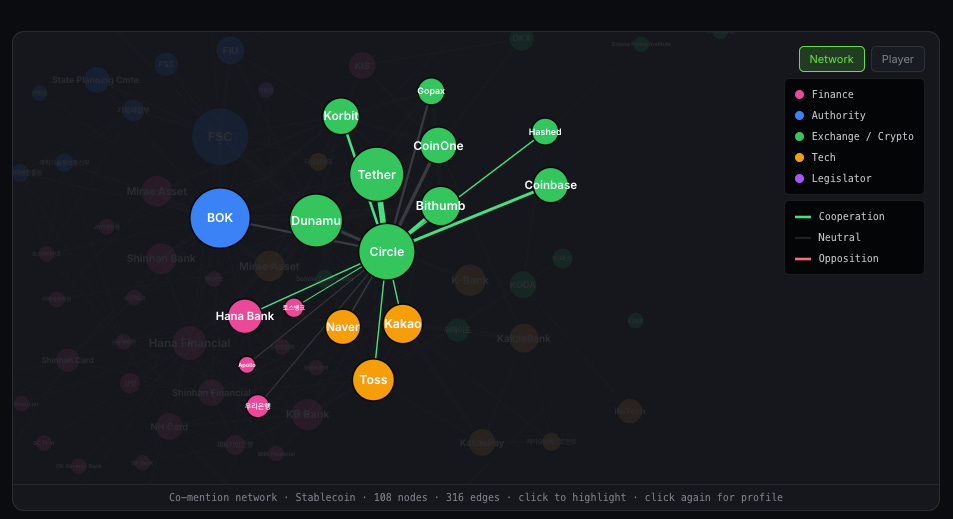
Big tech’s stablecoin race continues: Kakao and Toss are following up on their Circle MOUs, and Samsung Wallet has announced upcoming stablecoin support. The Bank of Korea created a new Asset Tokenization team under its Digital Currency Department, extending its ambitions to sovereign bond tokenization. Hana Financial’s decision to build cross-border remittance infrastructure on Dunamu subsidiary Lambda256’s GIWA chain reads as a signal that exchange-affiliated chains are becoming a default settlement layer. The stablecoin bill itself: still not submitted.
Regulation
The Digital Asset Basic Act’s submission to the Assembly keeps slipping, with September’s regular session now the effective deadline. The National Office of Investigation confirmed FSC and National Tax Service staff will be seconded to its new crypto-crime unit. A bill to repeal crypto taxation was formally tabled at the Finance and Economy Committee, but the committee’s own review office urged caution, and Deputy PM Koo Yun-cheul reaffirmed the tax will take effect as planned in January 2027.
STO/RWA
No major new deals, but state-level tokenization tracks keep multiplying: the BOK’s asset tokenization team, a proposed National Asset Basic Act covering state-owned real estate, DB Securities’ MOU with the Optimism Foundation to tokenize Jeju smart farms, livestock, and K-content IP, and Hanwha Group becoming Securitize’s largest shareholder with a 9.6% stake. KakaoPay Securities and Siebert are also moving ahead on round-the-clock tokenized trading of Korean stocks.
Security
A 22-month investigation in which a security researcher infiltrated Lazarus Group’s own servers put the first concrete numbers on the scale of the threat: 1,640 organizations targeted, 700 to 800 severely compromised. Bithumb rejected a 3 billion won ($2.2M) compensation order for API-event victims, opening the door to a lawsuit right as its KB Kookmin Bank real-name account renewal is under negotiation. It also emerged that the Bank of Korea’s CBDC pilot ran without an independent security audit.
Payment
Hana Financial’s cross-border remittance rail on Lambda256’s GIWA chain is now the fifth payment rail in the race, joining Kakao/Toss’s Circle partnerships, Samsung Wallet, and the Coupang-Woori Bank tie-up. Toss Payments was selected as preferred bidder for the government’s deposit-token infrastructure project. Across the board, infrastructure is going in well before the law exists to govern it.
Institutional
The clearest reversal: Kiwoom Securities’ bid to acquire a stake in Bithumb has effectively stalled, undone by the exchange’s complex ownership structure. Dunamu’s ecosystem, by contrast, keeps expanding through Hana Financial, Samsung SDS, and K Bank. Real-name account renewal season has arrived (Bithumb-KB Kookmin, Coinone-KakaoBank). Exchange trading volume hit a six-year low, while the share of Seoul home purchases funded by crypto and stock sales climbed from 2.9% to 7.6%.